Human Connection Matters More Than Ever
We live in a world where it has never been easier to communicate without actually speaking to another person.
We can send a message instead of making a phone call. Order food without talking to anyone. Check into a hotel using an app. Work remotely. Shop online. Ask AI to write an email, prepare a presentation, answer a question or help us decide what to say.
Much of this technology is incredibly useful.
But there is something it cannot do for us.
It cannot make a human connection on our behalf.
And for people who stutter, that matters more than ever.
Avoidance has never been easier
People who stutter can become incredibly skilled at avoiding speaking situations.
Change the word.
Let somebody else order.
Don’t ask the question.
Pretend you have forgotten what you wanted to say.
Send an email instead of making the call.
Choose the self-checkout.
Stay quiet in the meeting.
Say you went somewhere else on holiday because the actual destination is too difficult to say.
These behaviours can make life easier in the moment.
But every time we avoid, substitute or escape, we reinforce the idea that speaking is something to fear.
Technology didn’t create avoidance.
But it can make avoidance much easier.
The question therefore isn’t whether technology is good or bad. It is:
Am I using technology because it is the best tool for the job, or am I using it to escape speaking?
That distinction is important.
Connection requires us to speak
At the McGuire Programme, we don’t believe the answer is simply to accept whatever our stutter does and carry on regardless.
We actively work on it.
We work to counteract the physical behaviours of stuttering and the psychological behaviours that grow around them.
The blocks.
The freezing.
The panic.
The avoidance.
The word substitution.
The tricks.
The holding back.
The constant anticipation of what might happen when it is our turn to speak.
We learn physical techniques to gain greater control of our speech, and we work on the behaviours and fears that have often accumulated over many years.
Then we put that work into action.
Because learning techniques in a room is not enough.
We have to use them in the real world.
Get out there and speak
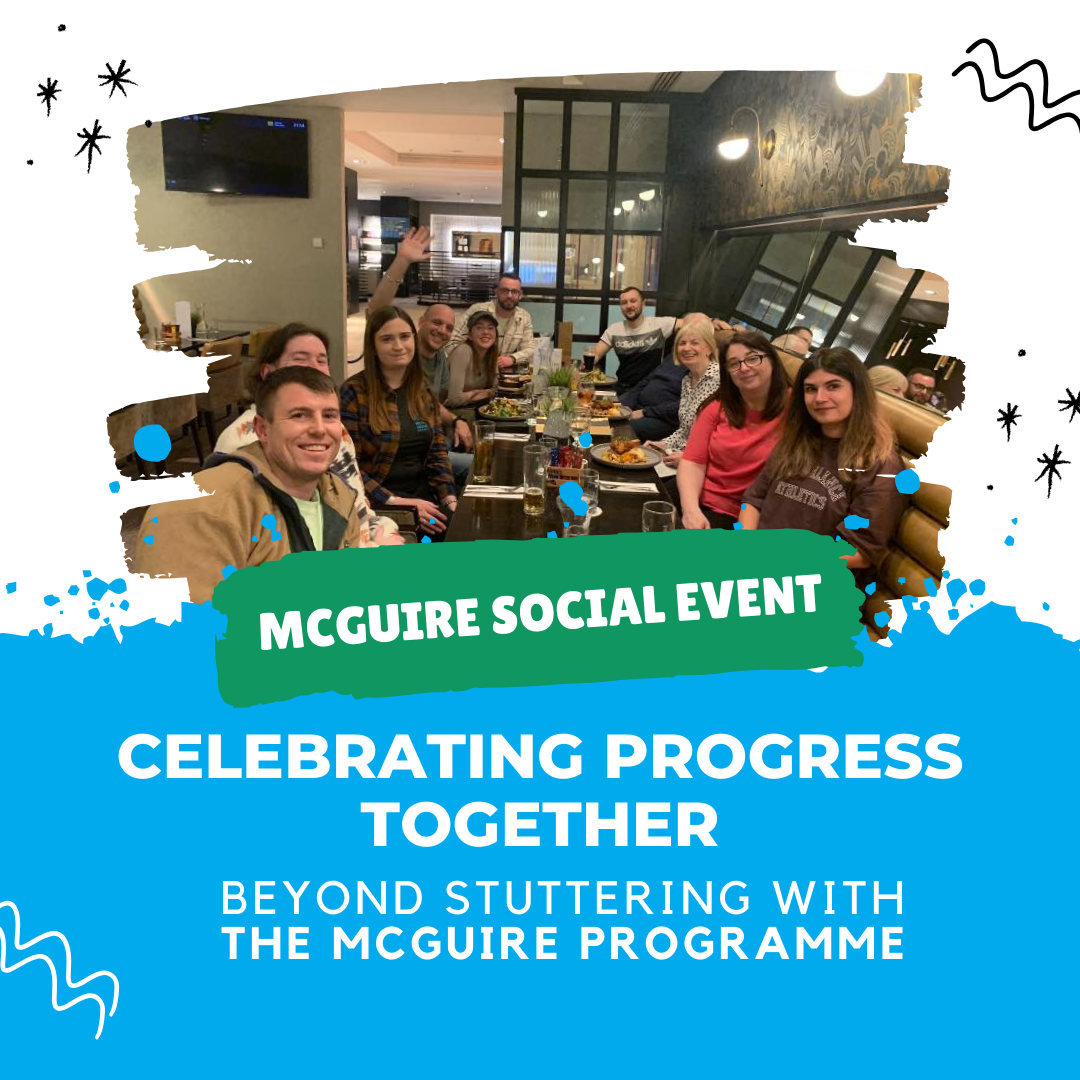
This is why speaking to people is such an important part of the McGuire Programme.
We make phone calls.
We approach strangers.
We disclose our stutter.
We deliberately tackle difficult words rather than avoiding them.
We ask questions.
We start conversations.
We speak in groups.
We stand in front of audiences.
We put ourselves into situations where previously we might have escaped, hidden or remained silent.
These aren’t exercises designed simply to prove that it’s OK to stutter in front of people.
The objective is much more demanding.
We are training ourselves to become stronger, more controlled and more effective communicators.
Every conversation gives us an opportunity to put our training into practice.
Pause.
Breathe.
Speak.
Release.
Use the tools.
Stay in the situation.
Say the word you intended to say.
Finish what you wanted to say.
And connect with the person in front of you.
Don’t let avoidance make your decisions
One of the most damaging aspects of stuttering isn’t always what comes out of our mouth.
It can be everything we do to prevent something from coming out of our mouth.
We may organise our lives around words.
Avoid certain people.
Avoid certain situations.
Avoid telephone calls.
Avoid introducing ourselves.
Avoid saying our own name.
Avoid opportunities at work.
Sometimes we become so good at these behaviours that nobody around us even knows they are happening.
That is why honesty is important.
Being open about our stutter doesn’t mean giving up on improving our speech.
Quite the opposite.
We can be honest about where we are while working hard to change where we are going.
We don’t need to pretend the problem doesn’t exist.
And we don’t need to pretend that being controlled by stuttering and avoidance is something we should be satisfied with.
We can acknowledge it.
Work on it.
Challenge it.
And improve.
Technology should support us, not hide us
AI is going to become an increasingly normal part of everyday life.
It can help us learn, organise, create and communicate. It can remove unnecessary work and give us access to tools and information that would once have taken hours to find.
Use it.
But we should also be conscious of what we are asking technology to do for us.
If you send an email because an email is appropriate, that’s one thing.
If you send an email because you’re frightened of making the telephone call, that’s something else.
If you order through an app because it’s convenient, fine.
If you order through an app every time because saying what you want is difficult, perhaps that is exactly the situation you need to tackle.
For a person who stutters, convenience can very easily disguise avoidance.
And avoidance is something we need to recognise and counteract.
Human connection is part of the training
The world is becoming increasingly automated.
That may make genuine human interaction even more valuable.
Our ability to walk into a room, introduce ourselves, speak to somebody we don’t know, express an opinion, ask a question, tell a story, make a telephone call and hold a conversation will continue to matter.
For people who stutter, those things may require work.
So we do the work.
We don’t wait until speaking feels easy before we participate.
We train.
We challenge ourselves.
We use our techniques.
We tackle difficult words.
We counteract avoidance.
We learn from the times it goes wrong and build on the times it goes right.
And over time, we work towards becoming the best communicators we can be.
Don’t outsource your voice
Technology can do remarkable things.
AI can write the email.
An app can place the order.
A chatbot can answer the question.
A screen can remove the need for a conversation altogether.
But there are some things worth doing ourselves.
Make the call.
Ask the question.
Order for yourself.
Speak in the meeting.
Say your name.
Say the difficult word.
Walk over and introduce yourself.
Have the conversation.
Don’t allow convenience to quietly rebuild the avoidance behaviours you have worked so hard to overcome.
Human connection still matters.
Perhaps now more than ever.
And sometimes the only way to make that connection is to put the technology down, look at the person in front of you, take your breath…
and speak.